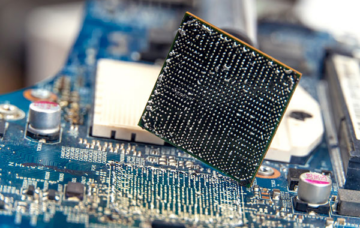
Which flux or solder paste should you use for BGA rework?
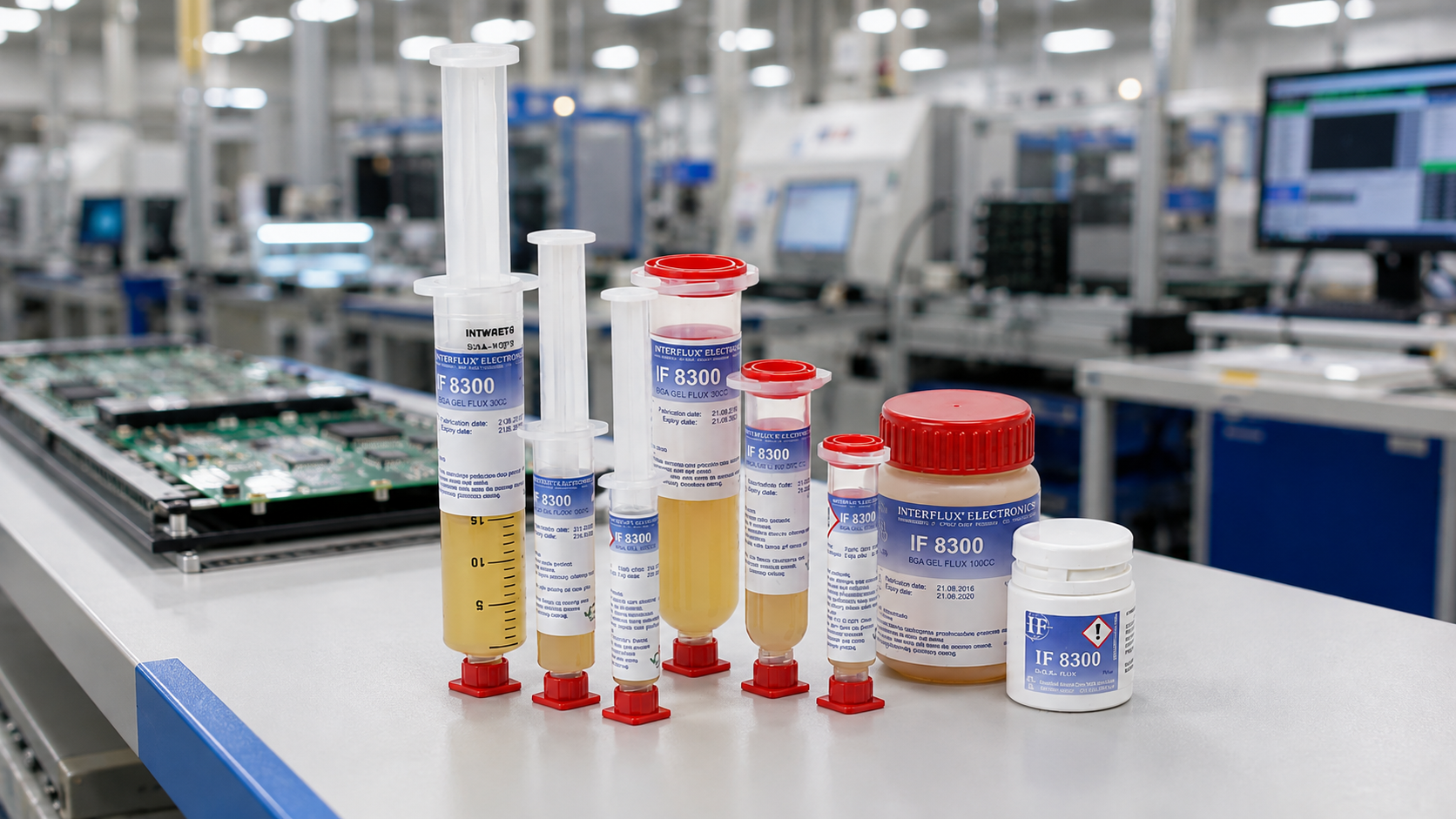
Flux plays a role at several stages of BGA rework. It can be used when desoldering a defective BGA, when preparing the pads and when soldering the replacement component.
But which flux should you use at each stage? And when should you choose solder paste or dip paste instead of flux alone?
The right choice depends not only on the BGA itself. The process step, application method, required amount of solder, flux activity and residues after reflow all need to be considered.
The first question is therefore not which flux is best?, but what does the flux need to do at this stage of the process?
Liquid flux for desoldering a BGA
Liquid flux can be a suitable choice when removing a defective BGA.
Because of its low viscosity, the flux can flow underneath the component through capillary action. There, it supports the soldering process while the joints underneath the BGA are heated.
Liquid flux can also be used when preparing the footprint after the BGA has been removed. Flux is applied to the pads before the remaining solder is removed, for example with desoldering braid.
Liquid flux is therefore particularly useful when the flux needs to flow easily and reach soldering surfaces that are difficult to access.
Tacky flux when placing a new BGA
Tacky flux can be more suitable when placing a replacement BGA.
It has a higher viscosity than liquid flux and therefore remains more easily where it is applied. Its tackiness can also help keep the BGA in position before reflow.
This makes tacky flux practical when both flux activity and some mechanical stability are required during component placement.
Higher viscosity, however, is not automatically better. It also affects how the product can be applied and how much material is deposited on the footprint.
The appropriate viscosity therefore depends on the complete process.
When should you use solder paste?
Flux supports the soldering process but does not add additional solder metal to the joint.
Solder paste does. It consists of flux combined with metal powder and therefore adds solder to the connection during reflow.
This can be relevant when additional solder metal is deliberately required in the new joint, for example when the connection needs to withstand mechanical loads such as vibration, shock or thermal cycling.
Using solder paste also introduces additional process parameters.
If the paste is applied to the footprint using a stencil, for example, the amount deposited needs to be controlled. The stencil, apertures, pressure and printing process all influence the result.
The question is therefore not only whether you need solder paste, but also how you can apply a reproducible amount.
Dip paste as an alternative to stencil printing
For BGA rework, dip paste can be an alternative to printing solder paste directly onto the footprint.
The paste is presented in a controlled layer. The solder balls of the BGA are then dipped into the paste. A defined amount adheres to the balls, after which the BGA can be aligned and placed.
This approach has a practical advantage: the paste is transferred via the BGA itself. You therefore do not have to print paste directly onto the PCB footprint in the same way for every BGA.
Process control remains important. The thickness of the dip paste layer influences how much material is transferred to the solder balls.
Dip paste is therefore not a different type of solder joint, but a different way of applying solder paste to the BGA in a controlled manner.
How do you choose the right flux chemistry?
Once you know whether you need liquid flux, tacky flux or solder paste, you still need to determine which chemical properties are appropriate for the process.
Three relevant factors include:
- the flux base;
- the activation level;
- the halogen content.
Activation level
Flux helps remove oxides and contaminants from the surfaces to be soldered, supporting proper wetting during the soldering process.
More activity, however, does not automatically mean a better flux.
When the surfaces are in good condition, a lower activation level may be sufficient. Higher activity can increase the process window, but it can also influence the properties of the residue left behind.
A useful principle is therefore:
Choose enough activity to achieve a reliable soldering process, but no more than the process requires.
What role do halogens play?
Halogens can increase the cleaning activity of a flux and therefore broaden the process window.
However, the reaction products remaining after soldering also need to be considered from a reliability perspective. Particularly when residues cannot easily be removed, halogen content should be taken into account when selecting the product.
For surfaces with good solderability, a halogen-free flux may be an interesting option.
Pay attention to the classification being used. Within technical standards, the term halogen-free does not necessarily mean the absolute absence of halogens. Always consider the product specifications together with the requirements of the application.
Consider flux residues before soldering
Residues require particular attention with BGAs.
Once the component has been placed, the solder joints and some of the flux residue are located underneath it. This area is difficult to access afterwards.
Trying to introduce a cleaning agent underneath the BGA may seem logical, but partially dissolving and redistributing residue does not necessarily result in a cleaner assembly.
A better question to ask beforehand is:
What happens to the residue of this flux after reflow?
Consider factors such as:
- the amount of residue;
- its chemical properties;
- cleanability;
- the cleanliness requirements of the final application.
If cleaning underneath the BGA is not practically feasible, this needs to be considered when selecting the flux.
Flux classification is a starting point
Flux classifications are useful for comparing products from a technical perspective. They provide information on properties such as flux base, activity and halogen content.
However, a classification does not tell you exactly how a product will behave in every specific BGA application.
Two fluxes within the same classification can still differ in viscosity, residue levels and practical process window.
Use the classification as a preselection tool rather than the final decision.
The final choice should match the PCB, component, solder alloy, application method and requirements after reflow.
Which chemistry suits which process step?
As a practical guideline:
| Process requirement | Possible choice | Main consideration |
|---|---|---|
| Flux needs to flow easily underneath a BGA | Liquid flux | Low viscosity and capillary action |
| BGA needs to remain in position during placement | Tacky flux | Viscosity and tackiness |
| Additional solder metal is required | Solder paste | Controlled paste volume |
| Paste is applied directly via the BGA balls | Dip paste | Controlled dip depth and layer thickness |
This is not a universal recipe. It is a way to start the selection process based on the function the chemistry needs to perform.
Choose chemistry as part of the complete BGA rework process
The choice between liquid flux, tacky flux, solder paste and dip paste cannot be separated from the rest of the BGA rework process.
The chemistry needs to suit the process step, application method, temperature profile and requirements of the assembly after reflow.
Smans and Interflux can assess which flux, solder paste or dip paste best matches the specific PCB, BGA and process conditions.
This means starting not with the products that are available, but with what the chemistry actually needs to achieve in your rework process.
Related trainings