BGA rework: how to determine the right temperature profile
In BGA rework, you need to apply enough heat to reliably melt all the solder joints under the component. At the same time, you want to limit the thermal load on the PCB, the BGA and the surrounding components.
That makes the temperature profile one of the most important parameters of the rework process.
However, there is no such thing as a standard profile. The right settings depend on the PCB, the component, the solder alloy and the thermal situation around the BGA.
The most important rule is therefore: don’t start from a fixed temperature, but from the actual temperature curve on the assembly.
Why can’t you simply use the original reflow profile?
During the original assembly, the entire PCB goes through a controlled reflow process. In BGA rework, the situation is different.
The circuit board is already fully assembled. Around the BGA, there may be components that were originally placed after reflow or that are more sensitive to a new thermal cycle. In addition, you heat locally, while the rest of the PCB absorbs and dissipates heat.
A profile that was suitable for the original reflow is therefore not automatically suitable for rework.
The profile for desoldering and resoldering doesn’t have to be the same either. When desoldering, you want to melt the existing joints just enough to remove the component safely. When placing a new BGA, a new solder joint has to be formed.
Start with the thermal mass of the PCB
One of the first factors you need to assess is the thermal mass.
A heavy multilayer PCB with a lot of copper absorbs more energy and spreads heat differently than a thin PCB with little copper.
This directly affects how fast you can heat up.
For a PCB with a high thermal mass, a lower heating gradient may be needed. This gives the heat time to spread through the assembly and limits large temperature differences.
A thin PCB with a low thermal mass responds faster and therefore requires a different setting.
Before setting up a profile, look at factors such as:
- thickness and build-up of the PCB;
- amount of copper;
- size of the BGA;
- surrounding components;
- materials used;
- possible presence of moisture.
Moisture in particular deserves attention. Heating too quickly can cause internal pressure and mechanical stress, with a risk of damaging the component or PCB.
Measure the temperature on the PCB at the component, not just in the heater
The set temperature of the heating element does not tell you what temperature the BGA actually reaches.
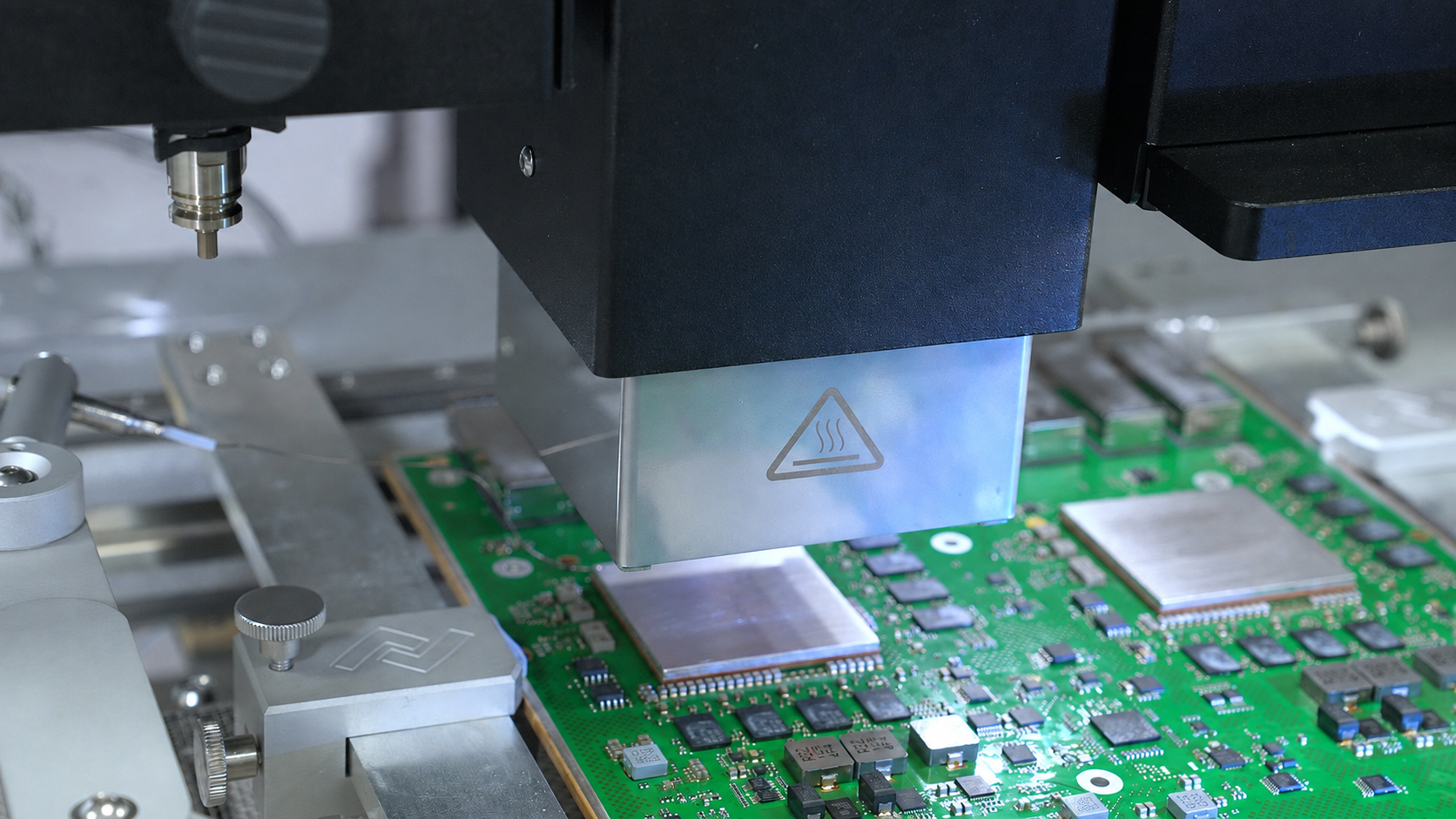
That is why a thermocouple is placed as close to the component as possible. This lets you follow how the temperature on the assembly actually evolves during the process.
That difference is important.
A heater can, for example, be much hotter than the temperature measured at the BGA, because part of the energy is absorbed by the PCB and components.
A good rework process is therefore controlled not only by heater settings, but by the measured temperature curve on the circuit board.
Why heat from both the top and the bottom?
In BGA rework, heat is usually applied from both the top and the bottom.
Bottom heating helps bring the PCB up to temperature gradually. Top heating can then add energy to the BGA in a more targeted way.
Especially with a PCB with a high thermal mass, this prevents all the required energy from having to be applied locally from above.
The goal is a controlled heat distribution: enough energy at the solder joints, without putting unnecessary stress on the BGA or surrounding components.
Temperature-sensitive components nearby can be shielded if necessary.
How fast can you heat a BGA?
As a starting point, BGA rework often uses a gradual, almost linear temperature profile.
For an assembly with a higher thermal mass, heating can for example take place at around 1 °C per second or lower. When even more time is needed for the heat to spread through the board, the gradient can be reduced further, for example towards 0.7 °C/s.
These are not universal settings.
The right gradient is determined by what the PCB and component actually need. Moreover, not all materials expand at the same rate during heating. Large temperature differences can therefore cause mechanical stresses.
Heating as fast as possible is therefore not the goal. Sufficiently uniform heating is more important.
How long should the solder stay above its melting point?
Liquidus is the temperature above which the solder alloy used is completely liquid.
In conventional reflow, longer times above liquidus are often used. In BGA rework, the required time can be shorter because solder is already present.
As a practical guideline for BGA rework, the source material mentions a time above liquidus of approximately 20 to 40 seconds.
This too is not a standard setting to be copied blindly. The required time depends on the alloy, the thermal mass and the purpose of the profile.
When desoldering, for example, the joint only needs to stay liquid long enough to remove the BGA safely.
What peak temperature should you use?
The peak temperature is determined by the solder alloy and the temperature limits of the PCB and components.
You need to get sufficiently above the melting point to achieve full reflow, but heating higher than necessary increases the thermal load.
For SAC305, for example, the source material mentions a melting temperature of around 219 °C. A possible peak is then around 239 °C, with the general advice to stay below approximately 245 °C where possible.
See these temperatures as guideline values, not as a universal BGA profile.
The component datasheet, the solder alloy and the measured temperature on the actual assembly remain decisive.
A good BGA profile is measured, not copied
The biggest mistake when setting up a BGA rework profile is looking for a single set of settings that can be applied to every PCB.
It doesn’t exist.
A suitable profile is created by assessing the assembly, choosing a starting profile, measuring the actual temperature close to the BGA and then fine-tuning the profile.
In doing so, you look at the interplay between:
Heating rate
Liquidus
Peak temperature
Thermal load
Smans can support you in setting up, measuring and optimizing temperature profiles for BGA rework. This way, the profile is tailored to the PCB and component you actually need to rework, rather than to a generic setting.
Related trainings