
Which flux and solder alloy should you choose for selective soldering?
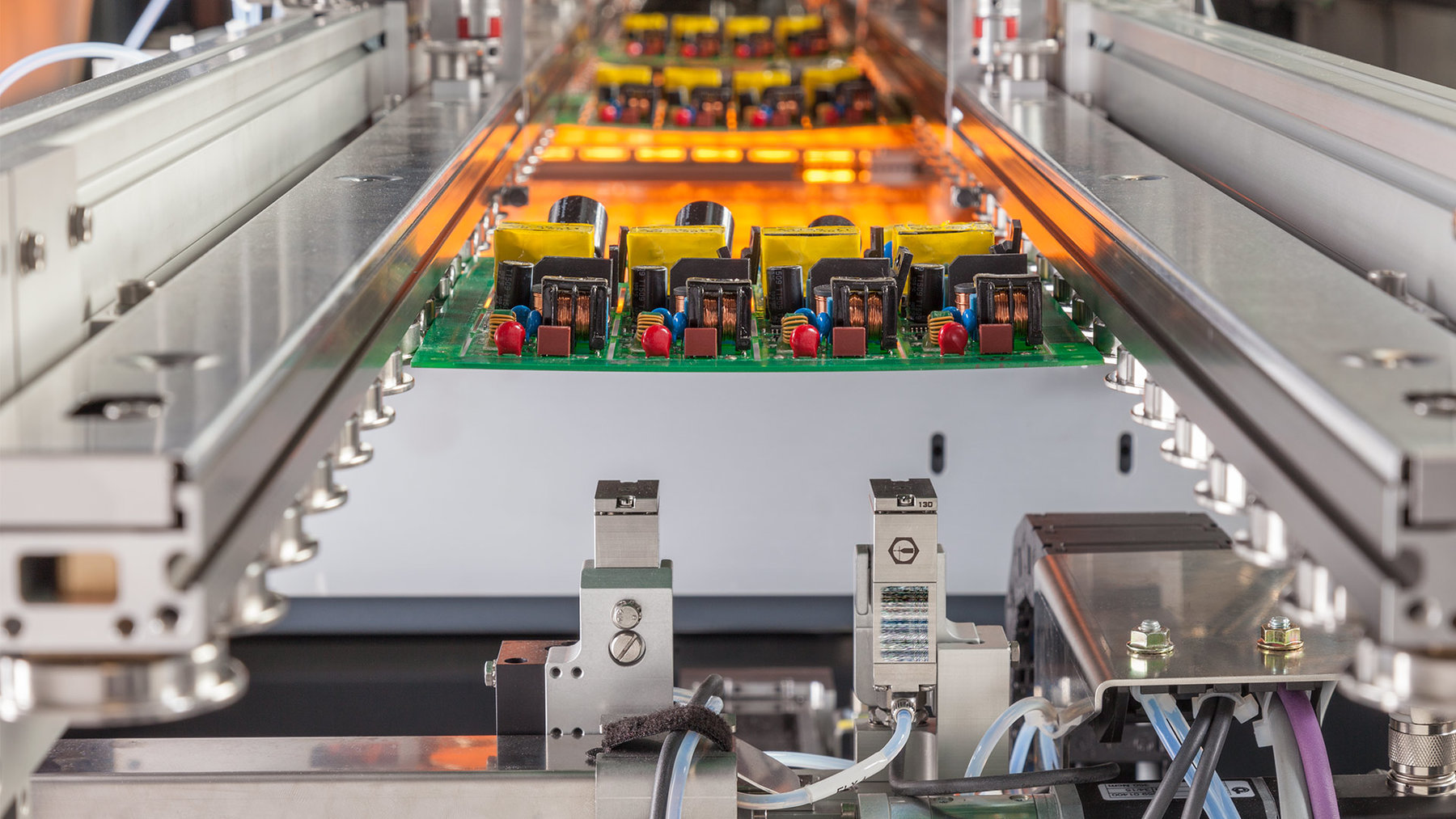
In selective soldering, much of the attention goes to machine parameters such as nozzle choice, soldering speed and preheating. But the flux and solder alloy used also help determine how large the process window is.
The flux is applied very locally and must remove oxides and enable wetting. The molten solder alloy must transfer enough heat to achieve good hole fill, while you want to limit the thermal load on the PCB and components.
That is why you don’t choose the right chemistry in isolation from the process. PCB, component, thermal mass, flux application, soldering temperature and the desired cycle time must all be considered together.
What does flux need to do in selective soldering?
Flux prepares the surfaces to be soldered for contact with the liquid solder. The active ingredients help remove oxides so that the solder can properly wet the metal surfaces.
With through-hole connections, this action must not only take place on the bottom side of the PCB; the flux must also be able to flow sufficiently into the space between the component lead and the plated through-hole.
That makes the way the flux spreads important.
In selective soldering, flux is usually applied locally, for example with a micro-jet fluxer. This allows very targeted application, and there is no need to apply flux to the entire bottom side of the PCB.
But it is precisely this local application that places specific demands on the flux.
Can you use the same flux for wave and selective soldering?
A flux that is suitable for wave soldering can in some cases also be used for selective soldering. However, that does not mean that every wave soldering flux is automatically a good choice.
The process conditions are different.
In wave soldering, a larger area is usually fluxed and then passed over the solder wave. In selective soldering, the flux is applied much more specifically, and only selected zones come into contact with the liquid solder.
As a result, flux residues may remain outside the effective soldering area. The amount of flux and where it is applied therefore deserve extra attention.
Suitability for the fluxer being used also plays a role. A flux that performs well in a particular soldering process is not automatically optimal for micro-jet application.
So the question is not only whether a flux solders well, but also whether it is suitable for the way you apply it.
Alcohol-based or water-based flux?
The solvent used plays an important role in the choice of flux.
Alcohol-based fluxes evaporate relatively easily during preheating. Water-based fluxes require more energy to evaporate the water sufficiently.
This has consequences for the preheating process.
If too much solvent is still present when the PCB reaches the liquid solder, it can disrupt the process. Preheating must therefore be tuned not only to the PCB and its thermal mass, but also to the flux being used.
A water-based flux can be perfectly usable, but it requires a process that provides enough energy and time for the water to evaporate.
Why is flux composition important for micro-jet fluxing?
A micro-jet fluxer uses a very small opening to apply the flux in a targeted way. The composition of the flux must be suited to this application method.
Fluxes that contain certain resins or solids may, depending on their formulation, be less suitable for very fine applications if deposits build up in the fluxer.
This can ultimately affect the reproducibility of the fluxing process.
When choosing a flux for selective soldering, you should therefore look not only at its chemical activity, but also at practical properties such as:
- suitability for micro-jet application;
- stability of the flux pattern;
- evaporation during preheating;
- amount and nature of the residue;
- required activation.
The best flux on paper is not necessarily the best flux for the equipment being used.
How active should the flux be?
Flux activity helps remove oxides from the solderable surfaces.
When surfaces are difficult to solder, higher activity can widen the process window. But more activity is not automatically better.
Stronger activators can also affect the properties of the residues left behind after soldering. This is particularly relevant in selective soldering, because not all fluxed zones necessarily come into contact with the liquid solder.
A good starting point is therefore:
use enough flux activity to achieve reliable wetting, but no more than the application requires.
The possible presence of halogens and the reliability requirements of the final electronics must also be taken into account.
When does a dedicated selective soldering flux make sense?
A dedicated selective soldering flux becomes interesting when a standard flux starts to cause limitations.
Consider, for example, situations in which:
- the flux cannot be applied reproducibly with a micro-jet;
- not enough flux gets through the through-hole;
- too much residue remains outside the soldering zone;
- the required activation does not match the solderability of the PCB and component;
- the available preheating process does not match the solvent well;
- solder balls or other process problems occur.
So the starting assumption need not be that selective soldering always requires a specific flux.
What matters more is assessing whether the flux fits the actual process. If it does not, a flux specifically tailored to selective soldering can widen the process window.
The solder alloy also determines the process window
Flux is only one part of the chemistry. The solder alloy also has a major influence on the selective soldering process.
An important property is the melting temperature.
Many lead-free processes use SnAgCu alloys such as SAC305. These alloys require relatively high process temperatures. This means that enough energy must be transferred to bring both the solder joint and the thermal mass of the PCB and component up to temperature.
This can become a challenge especially with heavy connectors, thick PCBs or a lot of copper.
You can respond to this by, for example:
- preheating to a higher temperature;
- allowing longer contact with the liquid solder;
- reducing the soldering speed;
- using a larger nozzle;
- adjusting the soldering temperature.
But every intervention has consequences for the process and the thermal load.
What can an alloy with a lower melting point change?
A solder alloy with a lower melting point can reduce the amount of thermal energy required.
This can offer interesting process benefits. A lower soldering temperature means less thermal stress on the PCB and components. In addition, in certain applications soldering can be faster because less energy is needed to bring the joint above its melting point.
This can therefore affect both the process margin and the cycle time.
However, an alloy with a lower melting point is not automatically the best choice.
Mechanical properties, reliability requirements, compatibility with component finishes and the requirements of the end application remain decisive. Changing alloys is therefore a far-reaching decision, not a simple machine setting.
Flux and alloy must be chosen together with the process
Suppose a joint shows insufficient hole fill. It can then be tempting to immediately choose a more active flux.
But perhaps the flux is not the problem.
The cause may also lie in insufficient preheating, a nozzle that is too small, a soldering speed that is too high, or a solder alloy that, combined with the thermal mass, demands too much energy.
The same applies the other way around. Adjusting a machine setting makes little sense if the flux being used is not well suited to the application method or the surfaces to be soldered.
That is why chemistry and machine parameters must be considered as one process.
Start with the application, not the product
There is no universal flux or solder alloy that is the best choice for every selective soldering application.
A stable process starts with the right questions:
- Which PCB and components need to be soldered?
- How large is the thermal mass?
- How is the flux applied?
- What activation is needed?
- Which residues are acceptable?
- Which solder alloy is used?
- What thermal load is permitted?
- What cycle time must be achieved?
Based on this, you can determine whether an existing flux is sufficient or whether a dedicated selective soldering flux adds value. The choice of alloy can then also be evaluated in light of the entire process.
Related trainings