Automatic Wire and Cable Taping: Consistent Finishing for a Reliable End Product
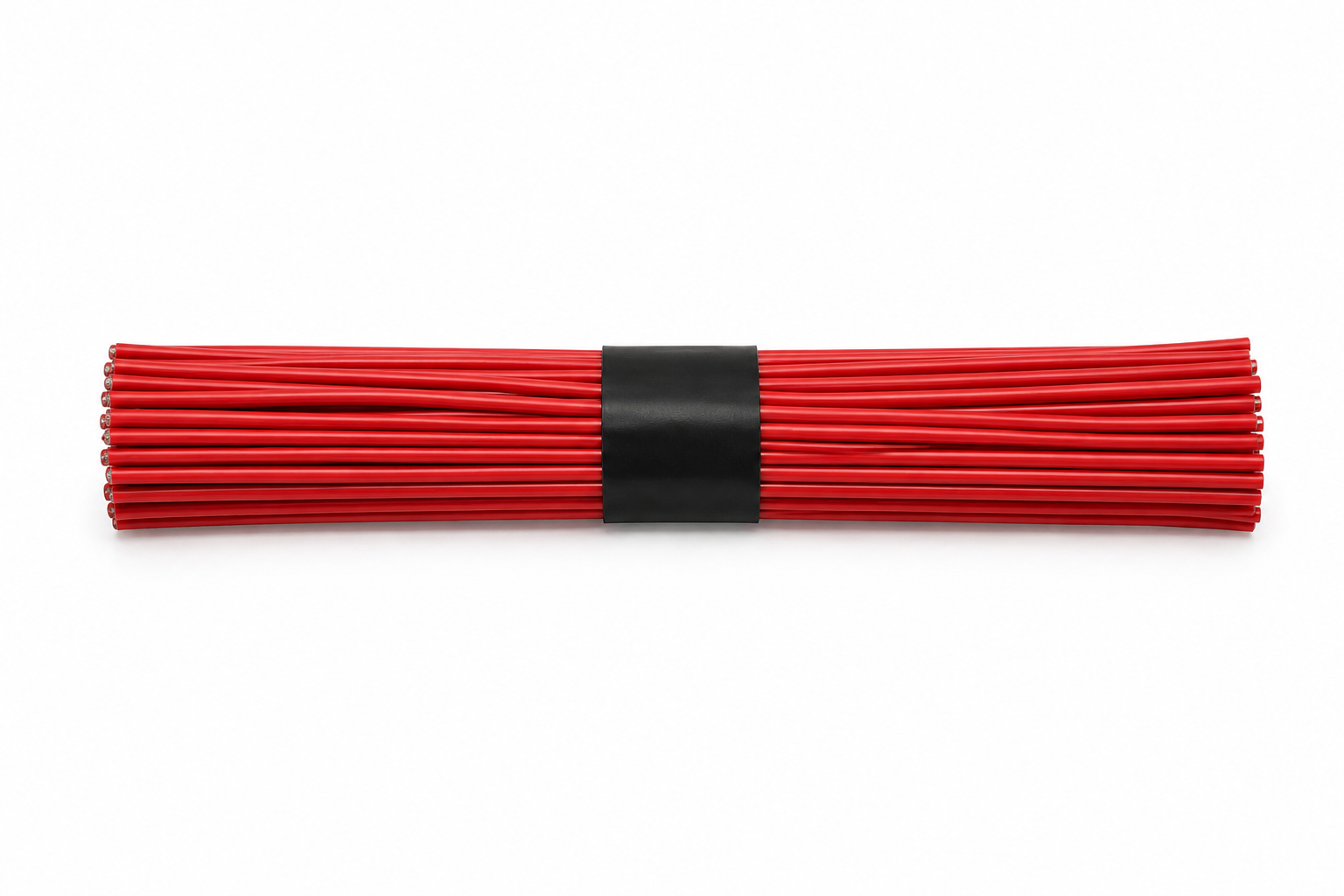
Taping is often one of the final steps in the production of wire harnesses and cable assemblies. Although it may seem like a simple operation, it plays a crucial role in the quality, protection and handling of the finished product.
Depending on the application, tape is used to bundle wires, provide local protection or temporarily secure cable assemblies during assembly. While these operations are still frequently performed manually, more and more manufacturers are automating the taping process—not only to increase productivity, but above all to ensure consistent quality.
Why are wires and cables taped?
Tape serves different purposes depending on the application.
Typical applications include:
- bundling multiple wires;
- providing local protection against abrasion;
- reinforcing sections of a cable harness;
- temporarily securing wires during assembly.
The type of tape and the way it is applied both have a direct impact on the quality of the finished product.
Spot taping or longitudinal taping?
Not every application requires the same taping method.
Spot taping
Spot taping applies tape only at one or several specific locations. It is typically used to hold wires together locally or to reinforce a particular section of a cable assembly.
Because tape is only applied where it is functionally required, cable flexibility is maintained while unnecessary material consumption is avoided.
Longitudinal taping
When a larger section of a cable requires protection or bundling, tape is applied over a longer distance.
In this process, the overlap between successive tape windings is essential. A controlled and consistent overlap ensures uniform protection and a clean finish along the entire length of the cable.
From manual to automated taping
In a manual taping process, the operator determines the tape position, tension and overlap. As a result, variations between products are almost inevitable.
In an automated process, these parameters are predefined. The tape is applied with controlled tension and a consistent overlap, ensuring every wire or cable is finished in exactly the same way.
In addition to fully automated systems, semi-automatic solutions are also available. Depending on the application, the operator may position the cable manually while the taping process itself is carried out automatically. This allows manufacturers to automate gradually without redesigning their entire production process.
Why automate?
The greatest advantage of automated taping is not simply higher throughput.
Automation also provides:
- consistent quality;
- controlled tape overlap;
- a repeatable production process;
- reduced dependence on operator skills;
- more efficient material usage.
For manufacturers producing cable assemblies or carrying out repetitive taping operations, automation results in a more reliable production process and a more consistent end product.
Typical applications
Automated taping is widely used in:
- cable assembly;
- machine building;
- panel building;
- industrial wiring.
Whenever the same taping operation is performed repeatedly or a consistent finish is required, automation offers significant added value.
Smans offers both semi-automatic and fully automated Komax taping solutions, tailored to the specific application, production volume and required flexibility.
Choosing the right solution
Not every production environment requires the same level of automation.
The choice between a manual, semi-automatic or fully automated taping solution depends on factors such as cable type, taping application, production volumes and the required flexibility.
That is why every successful automation project starts with a thorough analysis of the production process and the function the tape fulfils in the finished product.
Conclusion
A well-executed taping process contributes directly to the protection, reliability and quality of cable assemblies and wire harnesses.
By automating this operation, manufacturers not only improve productivity but also achieve a consistent and repeatable finish. This makes automated taping a valuable investment for companies striving for higher process efficiency and product quality.
Related trainings