
Why Process Control Matters More Than a Perfect Crimp
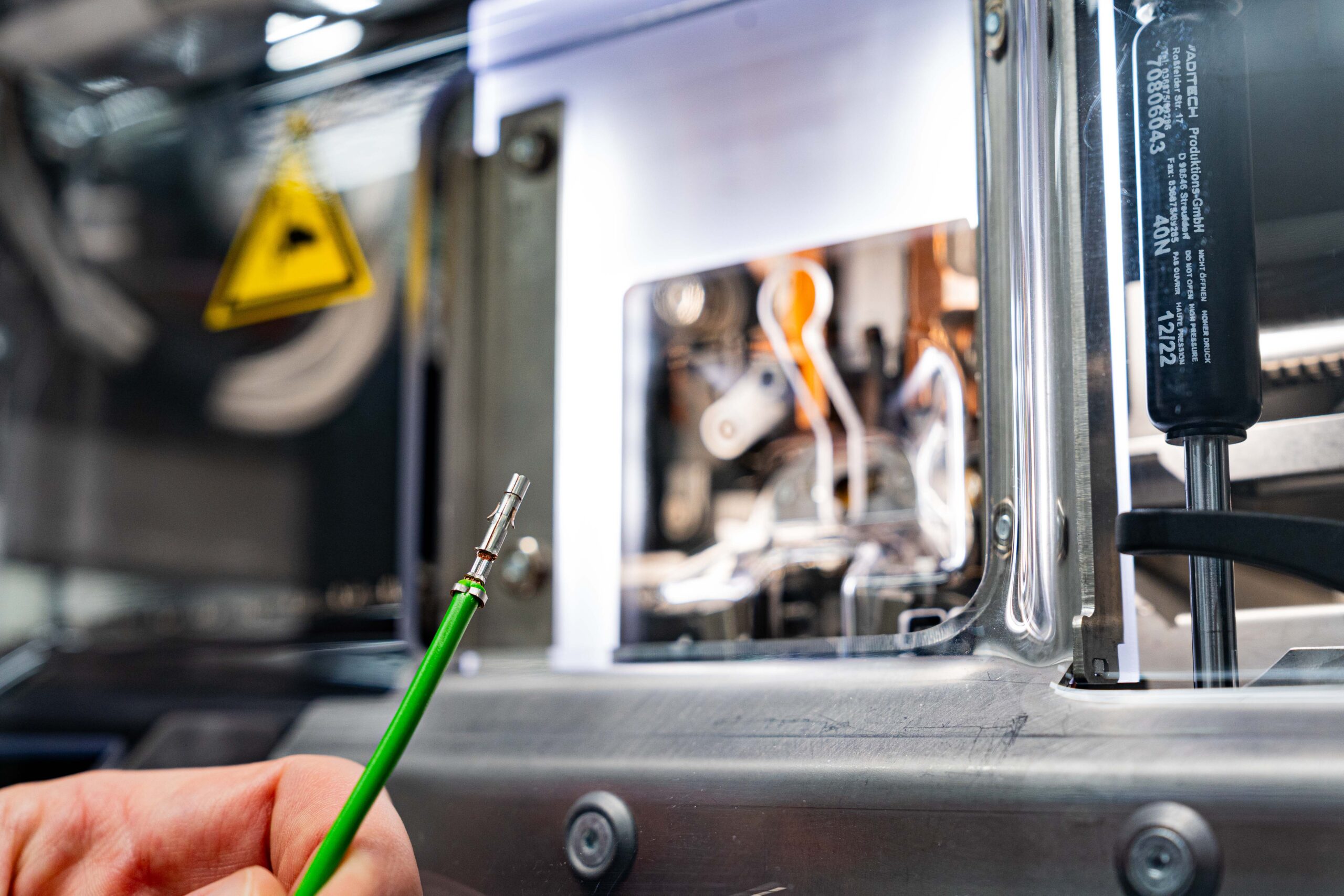
Anyone can produce a good crimp.
The real challenge is producing the next thousand crimp connections with exactly the same quality.
That is the difference between a manual operation and a controlled manufacturing process. In professional cable assembly, quality is not defined by a single successful crimp, but by the certainty that every connection delivers the same mechanical and electrical performance.
That is why manufacturers invest not only in better crimping machines, but above all in process control.
A Good Crimp Is More Than a Well-Adjusted Press
When discussing crimping, most attention is given to the crimp press or the machine. In reality, this is only one part of the process.
The quality of a crimp connection depends on the interaction of several factors, including:
- the characteristics of the wire;
- the selected terminal or contact;
- the correct applicator;
- machine settings;
- process parameters;
- quality control during and after production.
A deviation in any of these factors immediately affects the quality of the connection. That is why professional manufacturers focus on controlling the entire process rather than just the machine.
Repeatability Is the True Measure of Quality
An operator may produce a connection that fully meets the required specifications. However, this does not guarantee that the next hundred or thousand crimps will achieve the same result.
In serial production, repeatability is therefore more important than creating one perfect crimp.
Every connection must be produced using the same settings and under the same controlled conditions. Only then can manufacturers achieve a stable production process in which deviations are detected early and product quality remains predictable.
This is also why modern crimping processes are increasingly automated—not simply to increase production speed, but to minimise variation between products.
Quality Must Be Measured, Not Assumed
A crimp that looks good is not necessarily a good crimp.
Professional manufacturers therefore combine several inspection methods, each evaluating a different aspect of the connection.
Visual inspection remains an important first step, but objective measurements are essential to validate process quality. Common quality control methods include:
- crimp height measurement;
- pull testing;
- cross-sectional analysis (micrograph);
- inline Crimp Force Monitoring during production.
Each method provides different information. Together they create a complete picture of the quality of the crimp connection.
Crimp Height
Crimp height is one of the most important quality parameters in the crimping process. A deviation in crimp height often indicates a change in the process, such as applicator wear or incorrect machine settings. For this reason, crimp height measurement is widely used as the primary objective quality check for crimped connections.
Pull Testing
A pull test verifies whether the mechanical strength of the crimp meets the required specifications. This destructive test is typically performed during the validation of a new production run or after changes to tooling or process settings.
Cross-Sectional Analysis (Micrograph)
To understand what happens inside a crimp connection, external inspection alone is not sufficient.
Cross-sectional analysis involves cutting, polishing and microscopically analysing the crimp. This reveals how the wire strands are compressed, how much air remains inside the crimp and whether the connection complies with the applicable quality standards.
For this reason, micrograph analysis is often used to validate new applicators and production processes.
Inline Process Monitoring
For high-volume production, sampling alone is often insufficient.
Modern crimping systems therefore use Crimp Force Monitoring (CFM). During every crimp cycle, the system measures the force required to deform the terminal. Any deviation from the reference force curve immediately indicates a potential process variation, often before it becomes visible in the finished product.
Inline monitoring transforms quality control from an end-of-line inspection into an integral part of the manufacturing process.
Process Control Requires the Right Combination of Technology and Expertise
Machines can automate a process, but they cannot guarantee quality on their own.
A stable crimping process starts with the right combination of crimp press, applicator, terminal and wire. These elements must then be correctly configured, validated and continuously monitored. Even differences between wire suppliers or variations in conductor construction may require process adjustments to maintain consistent quality.
That is why process expertise is just as important as selecting the right equipment.
Conclusion
The quality of a crimp connection is not determined by a single perfect crimp, but by the ability to produce every connection with the same consistent quality.
Achieving this requires more than a high-quality crimp press or an experienced operator. It requires a controlled manufacturing process in which tooling, machine settings and quality assurance work together.
In modern cable assembly, the focus is therefore shifting from individual machines to complete process control. Ultimately, controlling the process means controlling product quality.