Which solder paste should you choose for stencil printing?
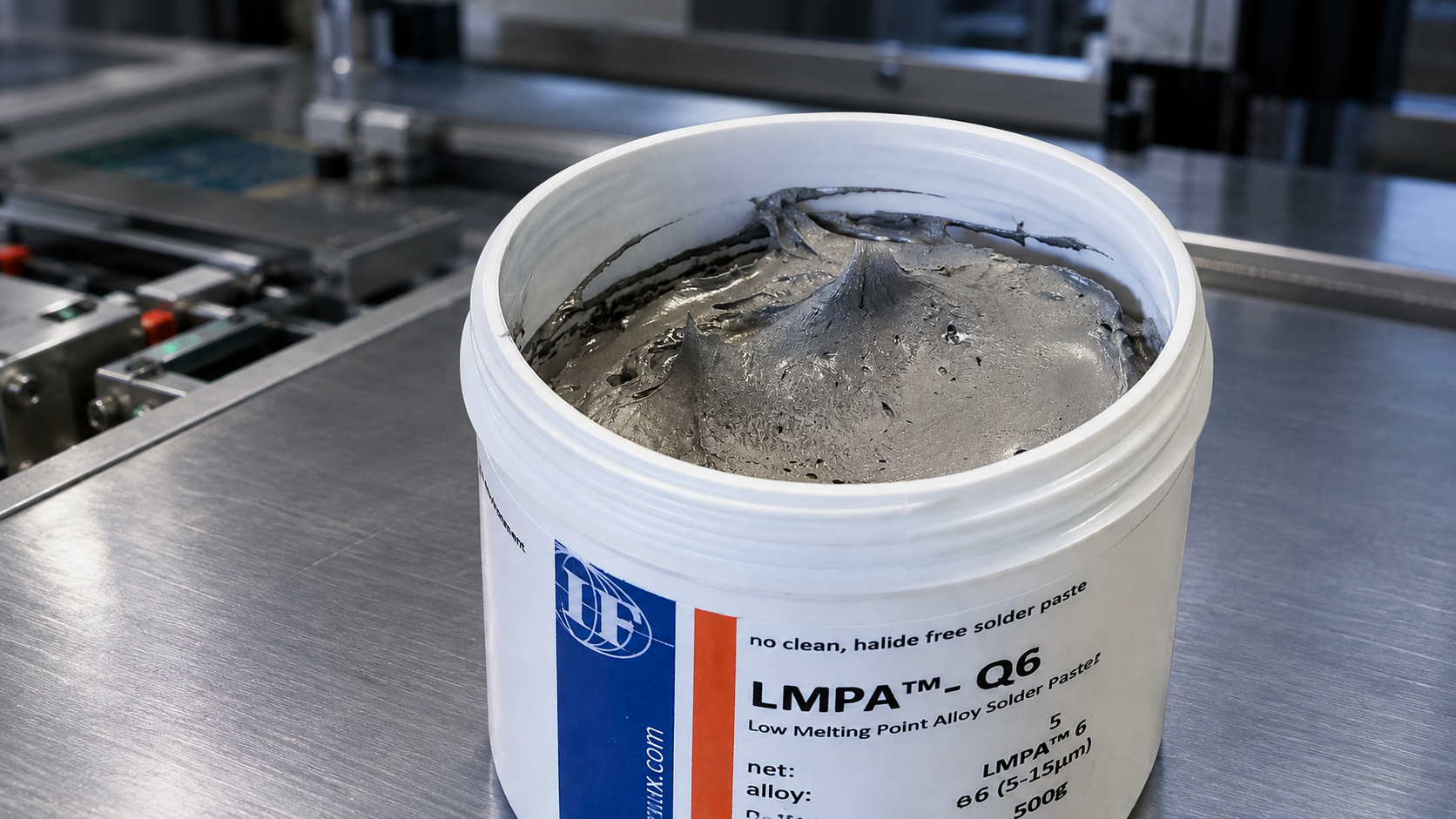
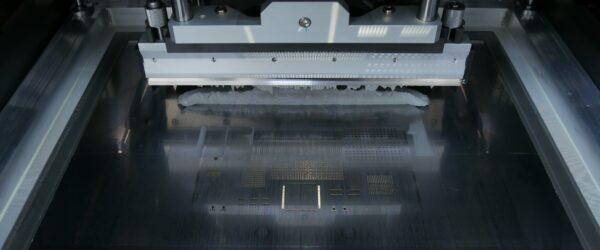
The choice of solder paste directly affects the stencil printing process. The alloy is not the only factor. Powder type, metal content, viscosity, tackiness and paste stability also influence how the paste behaves during production. The stencil printing process directly influences the choice of solder paste. It’s not just the alloy that matters, but also the powder type, metal content, etc.
The solder paste should therefore match both the stencil geometry and the process settings.
The powder type and the size of the apertures must be matched to each other.
Solder paste consists of a combination of solder powder and flux. The solder powder is available in different particle sizes, referred to as powder types.
For stencil printing, type 3, type 4 and type 5 are among the types used. The higher the type number, the smaller the solder particles in the powder.
The choice is related to the dimensions of the stencil apertures. Smaller apertures may require a finer powder type to achieve a good print result.
This is also related to the area ratio. As apertures become smaller in relation to stencil thickness, achieving good paste transfer becomes more challenging. The combination of stencil geometry and solder paste therefore becomes increasingly important.
Look beyond the alloy
The alloy influences the melting behaviour of the solder paste, but two solder pastes do not necessarily behave in the same way during stencil printing.
Properties such as metal content and viscosity also influence printing behaviour.
Tackiness is another relevant property. After components are placed in the printed solder paste, the paste needs sufficient tack to keep them in position before the reflow process.
A solder paste therefore needs to perform well both during printing and in the subsequent stages of the assembly process.
A stable paste contributes to a stable process
During production, solder paste remains on the stencil for a certain period of time. It is therefore important that its properties remain sufficiently stable.
Two relevant factors are stencil life and print pause. A temporary production stop should not make printing behaviour unpredictable when production resumes.
Temperature, humidity and drying can also affect the behaviour of the paste during use.
Solder paste performance should therefore not be assessed based on a single good print alone. Stability throughout the production process is also important.
Handling and pre-mixing
Correct handling starts with how the solder paste is stored and prepared for production.
Pre-mixing can also be part of this preparation. However, there is no universal procedure that can simply be applied to every solder paste.
Storage, preparation and mixing should therefore be adapted to the specific solder paste and its corresponding instructions.
Related trainings